Stay up
to date
New articles. New card offers. Clean strategy delivered straight. No noise, just the signal.
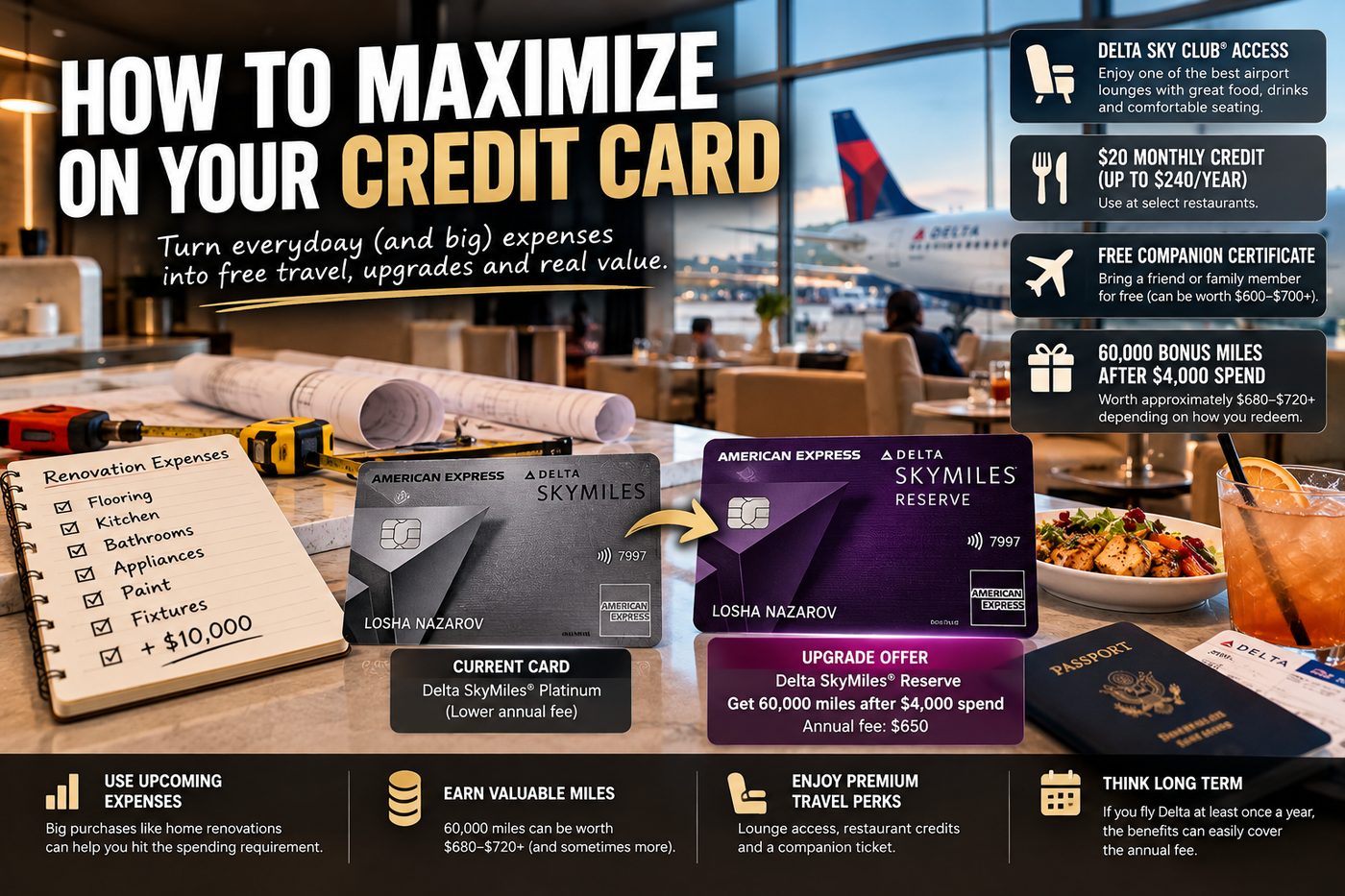
Most people think maximizing a credit card means spending more. It does not. Here is how I am using a condo renovation to unlock a Delta Reserve upgrade and 60,000 miles.
.jpeg)
Losha Nazarov I enjoy finding smart ways to earn more rewards from money I'm already spending.
The most common mistake I see with credit cards is the belief that more rewards require more spending.
They do not.
Maximizing a card is simpler than that. You take the expenses you already have, and you line them up with the right offer at the right time.
Right now I am doing exactly that, so I will use myself as the example.
What is in this guide
I already carry the Delta SkyMiles Platinum American Express. American Express sent me a targeted upgrade offer to move to the Delta SkyMiles Reserve.
The terms were straightforward.
Plenty of people stop reading at the annual fee. The Reserve runs $650, and that is not a small number.
But an annual fee on its own is not a decision. It is one line in a calculation.
I just bought a condo and I am renovating it.
Flooring, kitchen, bathrooms, appliances, paint, fixtures. I already know I am spending well past $10,000 over the next few months.
That changes the question completely.
It is not should I spend $4,000 to chase a bonus. That question has an easy answer and the answer is usually no.
It is since this money is leaving my account anyway, why would I let it earn nothing?
That is the whole idea behind this site. Not spending more. Not manufacturing purchases. Just routing money that was already committed through something that pays you for it.
If I had no renovation coming, I would not be taking this offer. The offer did not create the expense. The expense made the offer worth looking at.
Delta miles are not a fixed currency. What you get depends entirely on how you redeem them.
My working range is roughly 1.0 to 1.3 cents per mile, occasionally better on a good redemption.
| If you redeem at | 60,000 miles are worth |
|---|---|
| 1.0 cents per mile | $600 |
| 1.2 cents per mile | $720 |
| 1.3 cents per mile | $780 |
So the bonus alone roughly covers the annual fee, before a single benefit is used.
I want to be careful here though. That is the bonus, and a bonus is a one-time event. I wrote about why that matters in your points are not money. A signup or upgrade bonus makes any card look brilliant in year one. The real test is year two.
A premium travel card is only expensive when you are not using what it gives you.
Three benefits matter to me.
If you fly Delta, this is the headline perk, and Delta lounges are genuinely among the better ones. Real food, somewhere comfortable to sit, a drink, and an airport that stops feeling like an airport.
I already know what that is worth to me. On a recent Phoenix to Minnesota trip I used lounges on both ends, which I wrote about in the Portal Lounge MSP review. Travel with a kid once and you stop treating lounge access as a luxury.
Up to $20 a month, which is up to $240 a year.
I do not count that at full value, and neither should you. Monthly credits expire monthly. Miss four months and your $240 is $160. I plan around what I will realistically claim, not what the marketing page adds up to.
This is the one that moves the needle.
I recently flew Phoenix to Minnesota and the ticket was around $600. My son came with me and I did not pay for his seat.
That is not a theoretical benefit. That is a $600 line item that did not happen.
Use a certificate on a more expensive route and one certificate can be worth $600 to $700 on its own, sometimes more depending on dates and fares. For someone who flies Delta even once a year, that single perk can outweigh the entire fee.
Here is the calculation I actually ran, using the method from how to decide whether an annual fee is worth paying. Year one and every year after are separated on purpose, because lumping them together is how people talk themselves into bad cards.
| Line | Year one | Every year after |
|---|---|---|
| Upgrade bonus, 60,000 miles at ~1.2¢ | +$720 | — |
| Companion certificate, one domestic round trip | +$400 to $700 | +$400 to $700 |
| Dining credit, realistically claimed | +$150 | +$150 |
| Sky Club visits, say four a year | +$200 | +$200 |
| Annual fee | −$650 | −$650 |
| Net | +$820 or more | +$100 to $400 |
Look at that second column. Without the bonus, the card is somewhere between modestly positive and barely worth it, and that entirely depends on whether I actually use the companion certificate.
That is the honest picture. Year one is easy. Year two is a real decision.
A card making sense today does not mean it makes sense permanently.
Right now I have a renovation, a targeted offer, and travel habits that use Delta perks. The math works.
If that stops being true, I downgrade. That is a five minute phone call, it keeps the account open, and it protects my average account age.
People forget that option exists. You are not married to a credit card. You are evaluating whether it earns its place this year.
This move makes sense if most of these are true:
It does not make sense if:
There is no prize for holding the fanciest card. The goal is the card that fits the life you already have.
It depends almost entirely on the companion certificate and lounge access. If you use both, the fee is easy to justify. If you use neither, it is an expensive card with a nice metal finish.
No. If the spending requirement only works by buying things you did not need, the bonus is costing you more than it pays. Wait until a real expense lines up.
Sometimes. Upgrading keeps your existing account and its age, and targeted upgrade offers can be strong. A new card usually carries a bigger welcome bonus but adds an application. Neither is automatically better.
Roughly 1.0 to 1.3 cents in my experience, depending on the route and how far ahead you book. Treat anything above that as a good day, not a plan.
Too many people look at the annual fee and stop thinking.
A card is not good because it has a long list of perks. A card is good when those perks line up with how you already spend and travel.
This upgrade works for me because the renovation was happening regardless, the offer arrived at the right moment, and I will genuinely use the lounge and the companion certificate. Change any one of those and my answer changes too.
That is what maximizing a credit card actually looks like. Not more spending. Not more cards. Just making the money that was already leaving your account do a second job on the way out. It is the same principle behind building a reward stack.
Card terms, fees and upgrade offers change, and targeted offers vary by cardholder. Confirm current terms with American Express before you act on any of this.
New articles. New card offers. Clean strategy delivered straight. No noise, just the signal.